The NAR Settlement Plot Twist: Buyer Agent Commissions Actually Went Up

James
Author
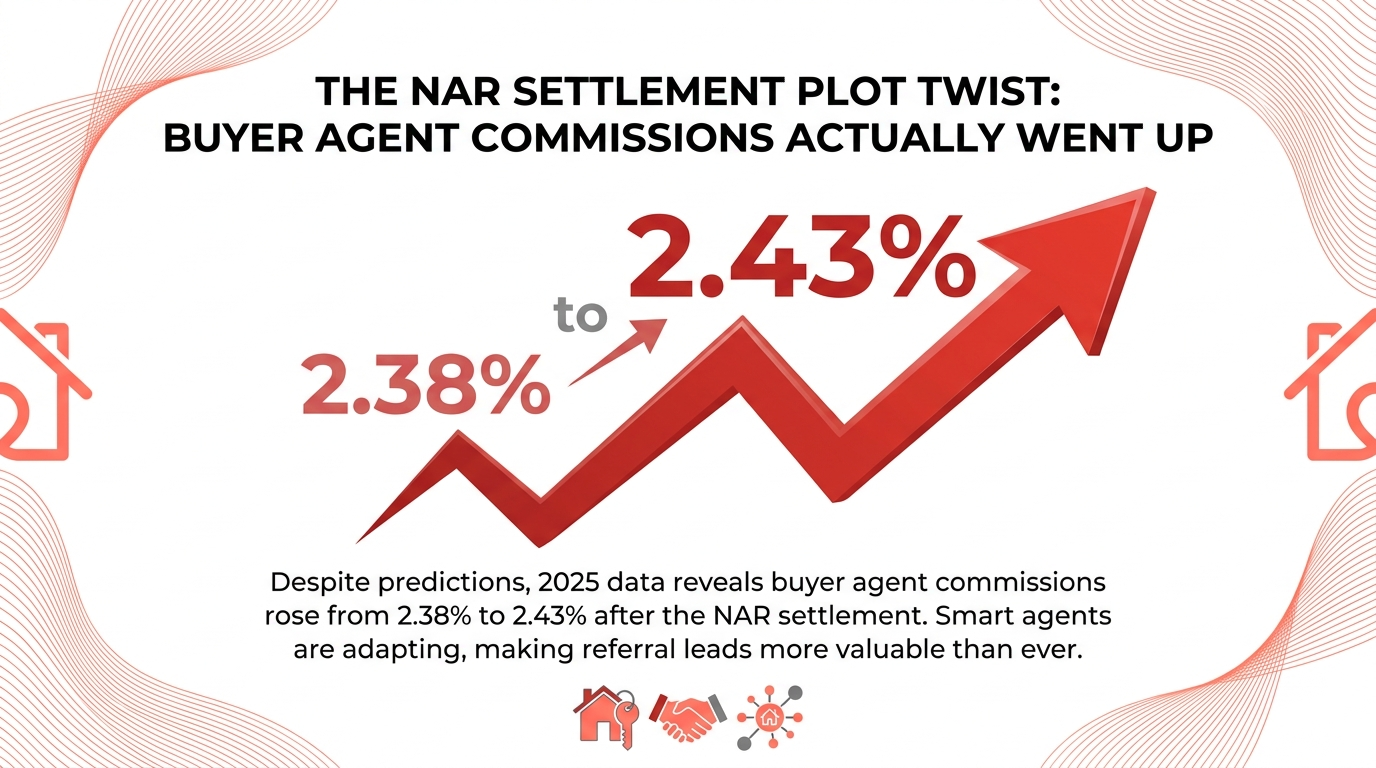
Remember all those headlines about the NAR settlement spelling doom for buyer's agents? Well, plot twist: the latest data from major brokerages shows ...
Remember all those headlines about the NAR settlement spelling doom for buyer's agents? Well, plot twist: the latest data from major brokerages shows buyer agent commissions actually increased from 2.38% to 2.43% in 2025. I know, I know – that's not what anyone predicted when the settlement hit in August 2024.
As someone who's been watching this unfold, I have to say the market's response has been fascinating. While everyone was bracing for commission cuts and mass exodus from the industry, something completely different happened. Turns out, when you force transparency and require buyer representation agreements, some interesting dynamics emerge.
What Really Changed After the Settlement
The big changes everyone was talking about were pretty straightforward: no more automatic commission sharing on the MLS, mandatory buyer representation agreements before showing homes, and complete fee transparency. On paper, it looked like buyers would start negotiating down commissions left and right.
But here's what actually happened in the field. In today's market, buyers have more leverage than they've had in years. Inventory is up, competition among buyers has cooled, and sellers are getting creative to attract offers. One of the most effective ways sellers are making their listings stand out? Offering competitive buyer agent commissions.
I've talked to agents across different markets, and they're seeing the same pattern. Sellers who want their homes to move quickly are advertising buyer agent compensation right in their marketing materials. It's become a selling point rather than a hidden cost.
The Psychology Behind Rising Commissions
There's some interesting psychology at play here. Before the settlement, commission splits felt automatic and somewhat arbitrary. Now that everything's transparent and explicitly negotiated, both buyers and sellers are thinking more strategically about agent compensation.
Buyers are realizing that their agent's commission directly impacts the quality of representation they receive. A buyer who negotiates their agent down to 1% might find themselves with less dedicated service when competing offers come in. Meanwhile, sellers understand that offering a competitive buyer agent commission can be the difference between sitting on the market for months or getting multiple offers.
The mandatory buyer representation agreements have also changed the dynamic. Agents now have clearer expectations set upfront about their compensation and scope of work. This has actually reduced the awkward conversations about commission that used to happen mid-transaction.
Regional Variations Tell the Story
The commission increases aren't uniform across all markets, which makes sense when you dig into local conditions. High-demand markets with limited inventory are seeing the biggest jumps in buyer agent commissions. Sellers in these areas are essentially using buyer agent compensation as a competitive tool.
In slower markets, commissions have remained more stable, but they haven't dropped as dramatically as predicted either. Even buyers who are price-sensitive are finding that experienced agents provide enough value to justify standard commission rates.
Luxury markets have seen some of the most interesting developments. High-end buyers are often willing to pay premium commissions for agents who can navigate complex transactions and provide white-glove service. The transparency requirements have actually highlighted the value proposition of top-tier agents.
The Referral Advantage in the New Landscape
Here's where things get really interesting for agents building sustainable businesses. The new transparency requirements and mandatory buyer agreements mean agents spend more time upfront explaining their value proposition. This can be exhausting when you're working with leads who found you through Zillow or cold calling.
But referral leads? Completely different story. When someone refers a buyer to you, they're essentially pre-selling your value. The referred buyer already trusts that you're worth working with because someone they trust vouched for you. This eliminates most of the awkward commission negotiations and value-justification conversations.
I've noticed that agents working with referred buyers rarely face pushback on standard commission rates. The buyer is more focused on getting good representation than negotiating fees down to the bone. This dynamic has made exclusive real estate referrals even more valuable in the post-settlement world.
Navigating Buyer Representation Agreements
The mandatory buyer representation agreement requirement initially felt cumbersome, but agents are finding their rhythm. The key is positioning it as a protection for both parties rather than just a legal requirement. Smart agents are using the agreement conversation to reinforce their value and set clear expectations.
The most successful agents I know have developed streamlined processes for explaining these agreements. They frame the conversation around mutual commitment – the buyer commits to working exclusively with the agent, and the agent commits to providing dedicated representation throughout the process.
Referral leads make these conversations significantly easier. When a buyer comes to you through a referral, they're already mentally committed to working with you. The buyer representation agreement becomes a formality rather than a sales hurdle.
Looking Ahead: Why Consistent Referrals Matter More Than Ever
The post-settlement market has created a clear divide between agents who struggle to justify their value and those who have built strong referral networks. Agents spending their time chasing leads from various sources often find themselves in lengthy discussions about commission rates and value propositions.
Meanwhile, agents with consistent referral sources are closing deals faster and with less friction. The warm introduction that comes with a referral eliminates most of the trust-building phase that typically slows down new client relationships.
This is exactly why having a reliable source of cheap real estate referrals has become so critical. Instead of spending energy justifying your commission to skeptical prospects, you can focus on what you do best – helping clients navigate real estate transactions successfully.
The commission increase data from 2025 proves that good agents who provide real value are thriving in the new environment. The challenge is positioning yourself to work with clients who already understand that value, rather than constantly having to prove it from scratch.
If you're ready to stop justifying your worth and start working with pre-sold prospects, it might be time to explore consistent referral sources that can keep your pipeline full of quality leads every month.